War is not courtesy but the most horrible thing in life
War and PeaceThe expression “War is not courtesy but the most horrible thing in life” crystallizes Prince Andrei Bolkonsky’s fierce moral and personal redefinition of warfare. Spoken as he prepares for the impending battle, it rejects the language of politeness, magnanimity, and military ceremony that disguises war’s actual purpose: people meet to kill and be killed. The statement also transforms Pierre Bezukhov’s understanding of the coming conflict, making visible the patriotism, gravity, and calm readiness for death among the soldiers.
Rejection of Chivalric Illusion
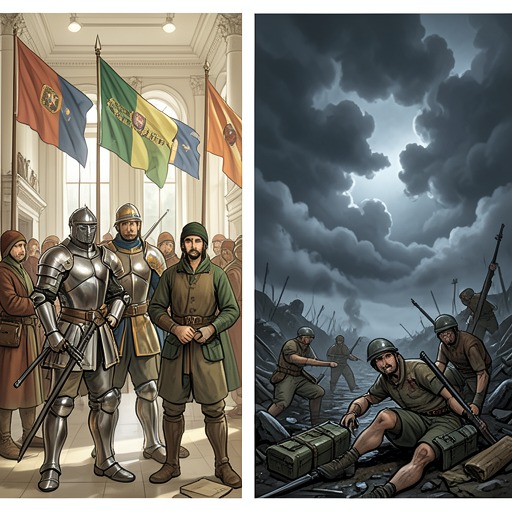
Prince Andrei’s formulation follows his denunciation of the supposed rules of war. He argues that flags of truce, mercy, chivalry, and magnanimity are fraudulent when set beside the plunder of houses, the issuing of false paper money, and the killing of civilians and family members. His recollection of the deceptions surrounding the 1805 campaign and the reference to Tilsit make military courtesy appear not as a protection against cruelty but as a language that permits cruelty to continue under a noble name.
He exposes the contradiction through a comparison with a woman who faints at the sight of a calf being killed yet enjoys eating the calf served with sauce. The image turns sentimental compassion into moral hypocrisy: horror is publicly performed at the spectacle of violence while the benefits of violence are quietly accepted. In the same way, armies speak of humanity while plundering, deceiving, and killing. The expression therefore attacks not only war itself but the social rituals that make war appear civilized.
War as Deliberate Violence
The sentence is immediately followed by an uncompromising definition of war: “Take no prisoners, but kill and be killed!” Prince Andrei argues that the aim of war is murder and that its methods include spying, treachery, the ruin of inhabitants, robbery for supplies, fraud, and falsehood presented as military craft. Discipline, which he describes as the absence of freedom, is joined to idleness, ignorance, cruelty, debauchery, and drunkenness. His catalogue strips away the prestige attached to the military class and replaces heroic vocabulary with an inventory of institutional violence.
The same argument extends beyond the battlefield. Prince Andrei observes that rulers wear military uniforms and that the person who kills the greatest number receives the highest rewards. Armies then hold thanksgiving services for having killed so many people, sometimes exaggerating the number, and proclaim victory on the assumption that greater slaughter means greater achievement. His anguished question about how God regards such conduct gives the expression a religious and ethical reach: warfare is not merely tactically dangerous but a human practice that challenges the legitimacy of its own honors.
A Demand for Moral Seriousness
Prince Andrei does not call for war to be made gentler through ceremony. He demands that its terrible nature be acknowledged. If war were stripped of false magnanimity, he argues, states would undertake it only when they were prepared for certain death; frivolous quarrels would no longer be dressed up as sufficient causes for mass slaughter. A serious war, such as the one facing Russia, would consequently produce a different determination in the troops, while foreign contingents led by Napoleon Bonaparte would be less readily carried into Russia and Russian forces would be less likely to fight in Austria and Prussia without understanding why.
His principle is therefore both ethical and political. War becomes less, not more, defensible when it is treated as a pastime, a career, or a theater of honor. The proper response to its necessity is not elegant language but stern recognition. Prince Andrei concludes that the falsehood must be removed so that war can be war rather than a game, condemning the military calling’s status as the favorite amusement of the idle and frivolous even while it remains the most honored profession.
Effect on Pierre Bezukhov
The expression marks a decisive change in Pierre Bezukhov’s perception. Pierre had been troubled by the meaning of the war while observing the army and the preparations for battle, but Prince Andrei’s words suddenly organize those impressions into a coherent understanding. The stern faces he had seen, the soldiers’ calm readiness for death, and the atmosphere surrounding the army are illuminated by what he recognizes as a latent heat of patriotism.
This change is not presented as abstract agreement alone. Pierre tells Prince Andrei that he agrees, and the conversation resolves the question that had disturbed him on the Mozhaysk hill and throughout the day. Prince Andrei’s expression thus functions as an interpretive key within the scene: it turns scattered visual impressions into a moral structure and makes the impending battle intelligible as a collective confrontation with death rather than as a ceremonial contest.
Emotional and Thematic Force
Although the sentence has the form of a maxim, it emerges from suffering rather than detached theory. Prince Andrei says that those who have reached this view through the same sufferings understand war differently. His speech falters when he considers that it might be all the same whether Moscow were taken as Smolensk had been; an unexpected cramp catches in his throat, his eyes glitter feverishly, and his lips quiver. The bodily interruption reveals that the maxim is bound to grief, anger, and personal loss.
The expression’s force lies in its refusal to let language soften experience. “Courtesy” implies manners, restraint, and reciprocal respect; “the most horrible thing in life” names the physical and moral reality that such manners conceal. By placing the two ideas in direct opposition, Prince Andrei turns a familiar social virtue into an indictment. His final insistence that people accept war as a terrible necessity “sternly and seriously” does not glorify violence. It demands an honesty severe enough to prevent violence from being mistaken for sport, honor, or civilized entertainment.